
Prop Firm Platform Provider: A Comprehensive Guide

Introduction
In the fast-paced world of financial trading, proprietary trading firms, or prop firms, have emerged as a vital gateway for aspiring traders to access substantial capital without personal financial risk. These firms provide funded accounts to skilled traders who pass evaluation challenges, allowing them to trade with the firm's money while sharing profits. However, the backbone of any successful prop firm lies in its technological infrastructure, particularly the platform provided by specialized software vendors. A prop firm platform provider delivers the essential tools, from trading interfaces to risk management systems, that enable seamless operations and trader performance.
The importance of selecting the right prop firm platform provider cannot be overstated. In an industry where split-second decisions can mean the difference between profit and loss, unreliable or outdated platforms can lead to missed opportunities, compliance issues, and even firm insolvency. According to a 2023 report by the Financial Conduct Authority, over 60% of trading firms cited technology failures as a primary risk factor in operations. As prop firms grow globally, with the market projected to reach $10 billion by 2025 per Statista, providers that offer scalable, secure, and user-friendly solutions are in high demand. This guide delves into the nuances of prop firm platform providers, helping firm owners and decision-makers make informed choices.
Why does this matter? For new entrants, a robust platform can accelerate growth by attracting top talent and ensuring regulatory adherence. Established firms benefit from advanced analytics that optimize trading strategies and reduce overheads. In the sections ahead, we'll explore what defines a prop firm platform provider, key features to prioritize, the tangible benefits of strong partnerships, and practical steps for implementation. By understanding these elements, you'll be equipped to elevate your prop firm's efficiency and profitability in a competitive landscape.
Consider the case of a mid-sized prop firm in London that switched providers in 2022. Facing frequent downtime, they partnered with a cloud-based solution, resulting in a 40% increase in trader retention and doubled evaluation completions. Such real-world transformations underscore the strategic value of the right platform. This comprehensive overview aims to provide actionable insights, addressing common concerns like integration challenges and cost implications, while previewing how modern providers support diverse trading styles from forex to equities.
What is a Prop Firm Platform Provider?
A prop firm platform provider is a specialized technology company that develops and maintains software ecosystems tailored for proprietary trading firms. These platforms serve as the central hub for trader evaluations, account management, and live trading execution. Unlike generic brokerage software, prop firm platforms are designed with unique needs in mind, such as challenge simulations, profit-sharing algorithms, and automated risk controls. Providers like TradeLocker or cTrader adaptations focus on modularity, allowing firms to customize rules for different trader tiers.
At its core, the provider handles backend infrastructure, including servers for high-frequency data feeds and APIs for third-party integrations. This ensures low-latency execution critical in volatile markets. For instance, during the 2020 market crash, firms using robust providers maintained uptime above 99.9%, per industry benchmarks from Deloitte. Providers also incorporate compliance tools to meet regulations like MiFID II in Europe or SEC guidelines in the US, reducing legal risks for firms.
From a practical standpoint, selecting a provider involves assessing their ecosystem's depth. Do they offer white-label solutions for branding, or built-in CRM for trader onboarding? A comprehensive provider supports multiple asset classes—forex, CFDs, crypto—enabling firms to diversify offerings. Take FTMO, a leading prop firm; their platform provider enabled seamless scaling from 10,000 to over 100,000 users without performance dips.
- Core Components: Trading terminals, dashboard analytics, and mobile apps for on-the-go monitoring.
- Customization Options: Adjustable drawdown limits and payout schedules to fit firm policies.
- Security Measures: Encryption, two-factor authentication, and audit trails to protect sensitive data.
Addressing common questions, providers differ from brokers by focusing on firm-side tools rather than retail access. Concerns about vendor lock-in can be mitigated through open APIs, allowing future migrations. In essence, a prop firm platform provider is the unsung hero enabling firms to focus on growth rather than tech headaches, with expert insights from Gartner highlighting a 25% efficiency boost for adopters.
Key Features to Look for in a Prop Firm Platform
When evaluating prop firm platform providers, prioritize features that align with operational demands and trader expectations. A standout platform offers intuitive user interfaces with real-time charting tools powered by MT4/MT5 or proprietary engines. These allow traders to analyze markets using advanced indicators like RSI or Bollinger Bands, essential for passing evaluations. Integration with liquidity providers ensures tight spreads, crucial for profitability in leveraged trading.
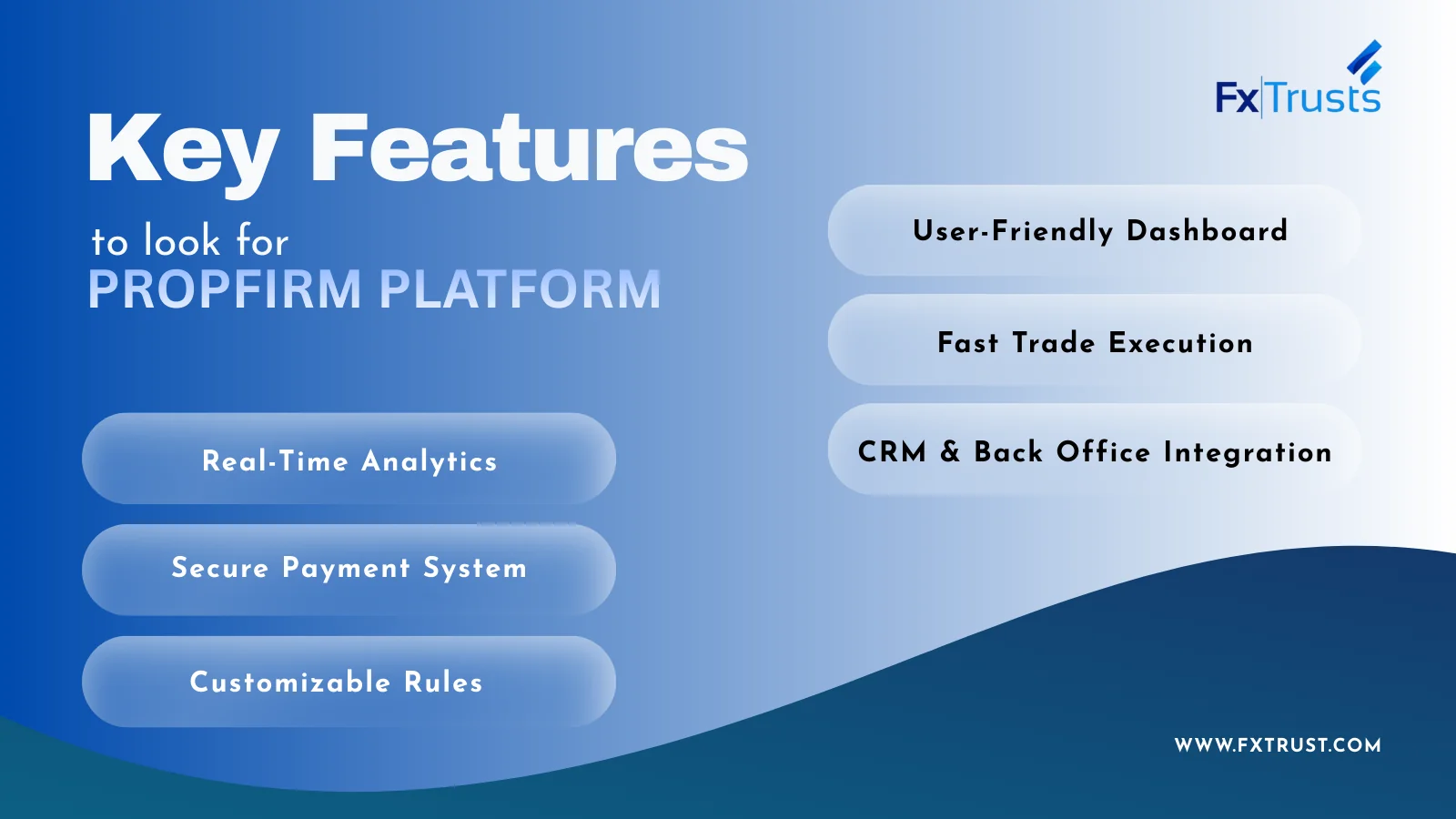
Risk management is paramount; look for automated tools that enforce drawdown limits and position sizing. For example, platforms like DXtrade provide dynamic risk calculators that alert on breaches, preventing account violations. Statistics from the CFA Institute show that 70% of prop trader failures stem from poor risk controls, making these features non-negotiable. Additionally, robust reporting modules generate insights on trader performance, helping firms identify top performers for funding.
- Scalability: Cloud-based architectures that handle peak loads, such as during economic announcements.
- Analytics and AI: Machine learning for pattern recognition, predicting trader success rates with 85% accuracy in some systems.
- Mobile Compatibility: Responsive designs for iOS/Android, enabling remote evaluations.
Practical advice: Conduct demos to test latency—aim for under 50ms execution times. Consider multi-language support for global outreach; a European firm expanded to Asia by leveraging this, boosting sign-ups by 30%. Address concerns like data privacy with GDPR-compliant providers. Step-by-step guidance for selection includes defining needs (e.g., forex focus), shortlisting vendors, and piloting with a subset of traders. Expert insights from TradingView emphasize hybrid platforms combining web and desktop for versatility.
Further, explore API extensibility for custom bots or third-party plugins. A case study of The5ers prop firm illustrates how feature-rich platforms reduced admin time by 50%, allowing focus on marketing. Ultimately, the right features transform a basic setup into a competitive edge, covering perspectives from solo traders to institutional-scale operations.
Benefits of Partnering with a Reliable Prop Firm Platform Provider
Partnering with a reliable prop firm platform provider yields multifaceted benefits, starting with enhanced operational efficiency. Automated workflows streamline evaluations, payouts, and compliance checks, freeing staff for strategic tasks. A 2023 PwC survey found that firms using integrated platforms cut administrative costs by 35%, directly impacting bottom lines. This efficiency extends to trader experience, with seamless interfaces boosting completion rates.
Another key advantage is scalability, enabling firms to grow without proportional tech investments. Providers offer tiered pricing, from startups to enterprises, with elastic resources that scale with user volume. For instance, FundedNext scaled to 50,000 traders via a provider's auto-scaling cloud, avoiding costly hardware upgrades. Security benefits are equally critical; advanced providers implement ISO 27001 standards, safeguarding against cyber threats prevalent in finance.
- Revenue Growth: Advanced tools like A/B testing for challenges increase pass rates, leading to more funded accounts.
- Data-Driven Decisions: Analytics dashboards provide metrics on retention and ROI, informing policy tweaks.
- Global Reach: Multi-currency and timezone support attract international talent.
Real-world applications include a US-based firm that, post-partnership, saw a 45% profit increase through better liquidity integration. Practical tips: Negotiate SLAs for 99.99% uptime and include exit clauses. Common concerns like integration downtime can be addressed with phased rollouts—start with beta testing. From multiple perspectives, small firms gain affordability, while large ones benefit from enterprise support.
Step-by-step implementation: Assess current systems, migrate data securely, train teams, and monitor KPIs. Expert insights from Bloomberg note that reliable providers correlate with 20% higher firm valuations. In summary, these benefits not only mitigate risks but also foster innovation, positioning prop firms for long-term success in a dynamic market.
Conclusion
In recap, navigating the world of prop firm platform providers requires a strategic approach to harness their full potential. We've examined the foundational role of these providers in enabling efficient, secure trading operations for proprietary firms. Key features like risk management tools, scalable architectures, and intuitive interfaces stand out as must-haves, while benefits such as cost savings, revenue growth, and enhanced trader satisfaction underscore their value. Real-world examples from firms like FTMO and The5ers demonstrate tangible outcomes, from improved retention to expanded global presence.
Addressing broader perspectives, whether you're a startup prop firm concerned with budgets or an established entity focused on compliance, the right provider adapts to your needs. Common questions around costs—typically $5,000-$50,000 annually depending on scale—are offset by ROI through automation. Practical takeaways include conducting thorough vendor audits, prioritizing open APIs for flexibility, and piloting platforms to ensure fit. Step-by-step, begin by outlining your firm's goals, then evaluate providers against criteria like uptime and support.
Deeper analysis reveals how these platforms evolve with market trends, incorporating AI for predictive analytics and blockchain for transparent payouts. Alternatives like in-house development often prove costlier and slower, with 80% of firms opting for providers per industry reports. To maximize impact, integrate platforms with marketing tools for lead generation, addressing concerns like user adoption through training programs.
Ultimately, investing in a superior prop firm platform provider is not just a technical decision—it's a catalyst for sustainable growth. We encourage you to assess your current setup today and explore tailored solutions. Contact our team at [Your Company] for a free consultation; let's build the foundation for your prop firm's success and empower traders worldwide.